 Reader Notes
Half a Cup of Coffee and Four Names From the Supplement Shelf, in a 74-Milliliter Peach Bottle: Each Line of the Panel Beside the Trial That Used It, and the One Line That Belongs at the Pharmacy Counter
Onnit's Alpha BRAIN Focus Shot is a small peach drink, one bottle a day, with 50 milligrams of caffeine and four other names on its panel. I set each one beside the study that tested it and at what dose, read the label's rule of one bottle in twenty-four hours, and found that the retailer's own photographs show a box with a different panel from the one printed on the same page.

This is a paid advertisement. Sponsored by iHerb, LLC.
Emmett Hartwell is the pen name of this desk.
Everything on this page about the bottle comes from the retailer's listing, the photographs of the box on that listing, and the maker's own product page, all read on September 19, 2026.
This page quotes no customer reviews, for a reason given in the ninth note.
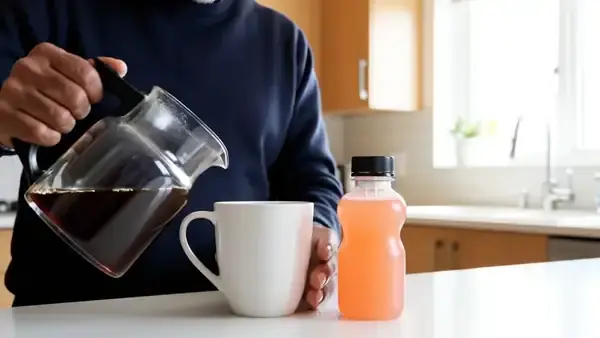
I drink my coffee black, one mug in the morning and half of another before noon.
So the first line I read on this box was the one about coffee.
It's printed in the cautions on the back, of all places.
"It contains the same amount of caffeine as half a cup of coffee."
Half a cup of coffee. Then four more names.
The Alpha BRAIN Focus Shot is a two-and-a-half-ounce bottle of peach-flavored liquid from Onnit, a supplement company in Austin, Texas.
It comes six to a box, and the label says to drink one a day.
The front of the box says it supports memory and focus.
The panel on the back lists the caffeine, two B vitamins, and four ingredients you can buy on their own at any supplement shelf.
So I did what I do with every label that reaches this desk: I read each line, found the trial behind it, and checked whether the dose in the bottle is the dose the trial used.
That's the whole method, and it's the only fair one.
One bottle a day, by the label, and never more than one in twenty-four hours. Every figure on this page is for one bottle.
Here's what I read, in order.
The caffeine, against your own coffee and against the government's daily figure.
The theanine, the citicoline and the lion's mane, each against the trial that used it.
And the club moss, which is the one line on this panel that belongs at the pharmacy counter before it belongs in your morning.
Then the vitamins, the fine print, and something I didn't expect: two different panels for one product on the same retailer's page.
What I found is an honest caffeine dose, two ingredients at the dose of a small trial each, one at a thirteenth of its trial, one that acts on a body enzyme the way some daily medicines do, and a brand whose one trial was run on its capsules, in people under 35.
One more thing before the first note, because most of you got here from one of our own advertisements.
Those ads talk about a boxed cereal, three foods, three drinks, and three words or phrases a man is supposed to be able to say.
None of that is in the bottle, and I won't pretend it is.
It's on this page, in its place: the tenth note, with the studies, and the honest version of every headline we run is in the guide linked at the foot.
Note one · The bottleSix Bottles to a Box, One a Day, Shake Well, and a Rule About Twenty-Four Hours
This is what arrives.
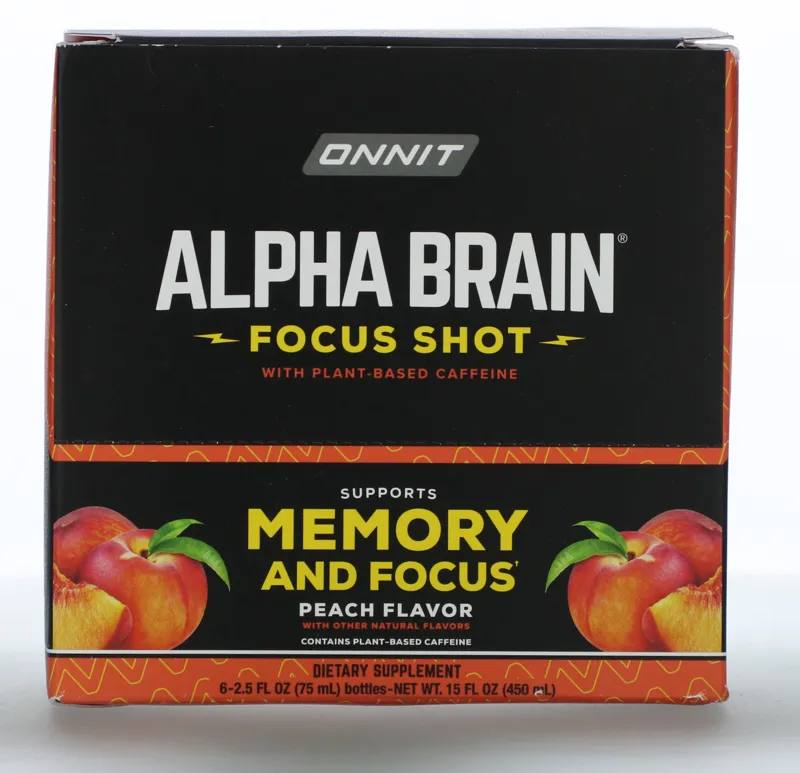
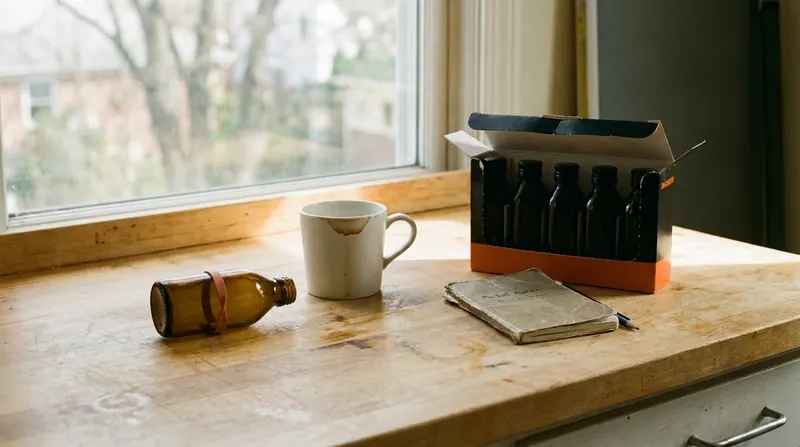
A black and orange carton, six small bottles inside, each holding two and a half fluid ounces, which the listing calls 74 milliliters.
The flavor is peach, and there's a tropical one too.
The directions are short.
Adults drink one bottle a day, shake it well, and serve it chilled.
Then two rules I'd underline.
Don't drink more than one bottle in twenty-four hours, and don't combine it with any other Alpha BRAIN product.
The cautions add three more lines.
Ask a clinician first if you have a condition or take anything daily; don't drink it at bedtime; and don't drink it if pregnant or nursing.
One bottle, once a day, alone, and not at night.
That's the label's own shape for this product, and every note below is read inside it.
Note two · The half cupFifty Milligrams of Caffeine, Your Morning Mug, and the Government's Daily Figure
The line with the clearest effect on this panel, and the one easiest to measure against your own kitchen.
Each bottle has 50 milligrams of caffeine.
The label compares it to half a cup of coffee, and that's a fair comparison.
The Food and Drug Administration puts a 12-ounce cup of brewed coffee at anywhere from 113 to 247 milligrams. [1]
It cites 400 milligrams a day, two to three of those cups, as an amount not generally tied to negative effects in most healthy adults. [1]
Europe's food safety agency reached the same 400-milligram figure for a day, and 200 for a single serving. [2]
It also says caffeine in moderate amounts makes people more alert and less sleepy, which is the one effect on this panel nobody argues about. [2]
It's a real dose of caffeine. It's half a mug of it.
So count it with your coffee.
If you drink two mugs before noon and add a bottle, you're somewhere near the middle of the daily figure, and nowhere near the top.
There's one small study that matches this bottle's caffeine exactly.
Twenty-seven volunteers took 50 milligrams of caffeine with 100 of L-theanine, and an hour later they were faster and more accurate on a task that switched attention back and forth. [3]
That was a single dose, in 27 people, run by researchers from a tea company, and the paper doesn't give their ages. [3]
But it's the closest thing on file to what's in this bottle, and it's a result about the next hour, not the next year.
The same agency lists what too much caffeine brings: a faster heartbeat, the jitters, an upset stomach, a headache and a bad night. [1]
That's why the label says not at bedtime, and why I'd drink this bottle, if at all, before lunch.
Half a mug of coffee's caffeine, with a real, short-lived effect on alertness and one small study at exactly this dose. Count it with your coffee and keep it out of the evening.
Note three · The tea leafTwo Hundred Milligrams of L-Theanine, the Amount of a Four-Week Trial
The second line, and the one that comes from tea.
L-theanine is an amino acid found almost only in tea leaves, and it's part of why green tea tastes the way it does.
A cup of brewed green tea holds very roughly 25 to 60 milligrams, so this bottle's 200 is several cups' worth.
Two studies are worth your time.
In Japanese adults aged 50 to 69, a single dose went with faster reactions on an attention task and fewer errors on a short-term memory task. [4]
That summary doesn't state the dose, so I can't tell you whether it matches this bottle.
The second study does, and it's the reason this line gets a fair mark. [4]
Thirty healthy adults, average age 48, took 200 milligrams a day for four weeks, and their scores on word fluency and on a planning task went up. [5]
Against the placebo weeks, the word-fluency gain showed up in the half who started with lower scores. [5]
Two hundred milligrams a day is the dose that trial used, and it's the dose in this bottle.
Thirty people, four weeks, and two of the authors worked for the company that supplied the theanine: that's the honest size of it. [5]
Theanine at the dose of a small four-week trial in adults around 48, with a word-fluency result and a supplier on the paper. The fairest line on the panel after the caffeine.
Note four · The choline lineTwo Hundred Fifty Milligrams of Citicoline, a Trial at Exactly That Dose, and a Memory Trial at Twice It
The line the box names first, after the brand.
Citicoline is a compound your body makes from choline on the way to building cell membranes.
The one in this bottle is a branded form called Cognizin, made by a Japanese company.
There's a trial at exactly this dose.
Sixty healthy women aged 40 to 60 took 250 or 500 milligrams a day, or a placebo, for 28 days, and the 250-milligram group made fewer errors on a computer attention test. [6]
Several of the authors were affiliated with the company that makes the ingredient. [6]
The test was about attention, not memory, and nobody in the trial was a man.
The memory trial used twice as much.
A hundred healthy adults aged 50 to 85 with mild memory complaints took 500 milligrams a day for twelve weeks, and the citicoline group improved more on a test of remembering word pairs; memory scores rose in both groups. [7]
So this bottle carries the attention trial's dose and half the memory trial's dose.
That's a better match than most panels on this desk, and still half.
Choline itself comes from eggs, milk, meat and beans.
In the Framingham families, people whose diets carried more of it scored better on memory tests, which is an association across a town, not a result for a bottle. [8]
Citicoline at the dose of a 28-day attention trial in women 40 to 60, and at half the dose of a twelve-week memory trial in adults 50 to 85. A real line at a fair dose, with a maker on one paper.

Note five · The mushroomA Quarter of a Gram of Lion's Mane Against the 3.2 Grams of Its Trial
The line with the most famous name and the smallest dose, measured against its trial.
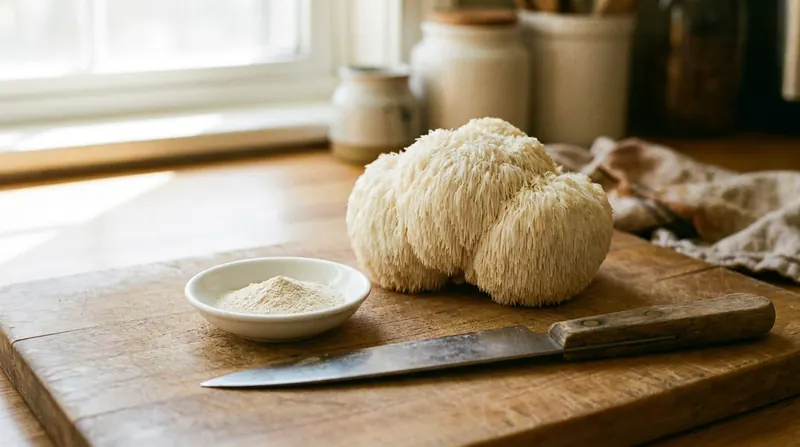
Lion's mane is an edible mushroom with long white spines that grows on old beech and oak trees.
People eat it; cooks compare the texture to crab.
Its best-known trial gave 31 healthy adults over 50 a lion's mane preparation of 3.2 grams a day for twelve weeks, and they scored higher on a standard mental-status test than the placebo group. [9]
A test of visual memory in the same trial didn't move. [9]
This bottle has 250 milligrams.
That's about a thirteenth of the trial's daily amount.
A second, smaller trial gave young adults a single 1.8-gram dose and found faster performance on a color-and-word task an hour later. [10]
That's seven times this bottle, in people aged 18 to 45.
I like mushrooms, and I'd rather see lion's mane on a plate than on a panel at a thirteenth of its trial.
On this label, it's a name, and the dose doesn't reach the study.
Lion's mane at about one-thirteenth of the 3.2 grams a day in its twelve-week trial in adults over 50. A real ingredient at a dose no trial has tested.
Note six · The club mossA Tenth of a Milligram of Huperzine A, Which Acts on a Body Enzyme the Way Some Daily Medicines Do
The smallest number on the panel, and the one I'd take to the pharmacist before the first bottle.
The panel lists 10 milligrams of an extract of Huperzia serrata, a club moss, standardized to one percent huperzine A.
One percent of 10 milligrams is a tenth of a milligram, or 100 micrograms.
The maker's own page explains what it does in plain words: it helps slow the breakdown of acetylcholine, one of the chemical messengers between nerve cells.
That's accurate, and it's the reason this line is different from the other four.
A small study in healthy adults gave single doses of 100 or 200 micrograms and confirmed the effect in the blood: the enzyme that breaks down acetylcholine slowed. [11]
The 200-microgram dose kept recall steady across sessions, but neither dose improved overall performance. [11]
So this bottle carries the lower of the two doses in that study, and the study's own result at that dose was an enzyme change, not a better score. [11]
The smallest number on the panel is the one that acts like a medicine.
Here's why that matters to a man over 55.
Some daily medicines work on that same enzyme, and some work in the opposite direction, and a compound that slows it can add to the first kind or argue with the second.
The label's cautions cover it only in general terms: ask a clinician first if you take anything daily.
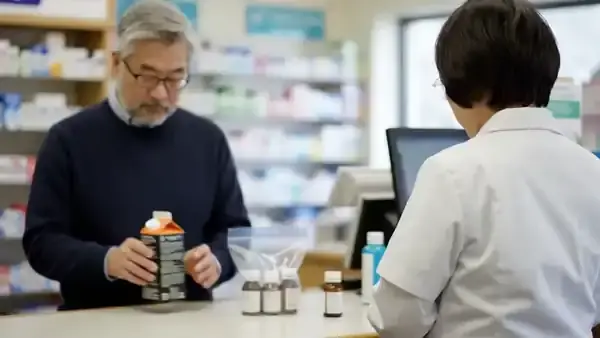
Take the box to the pharmacist with the rest of what you take, and ask about the club-moss line by name.
That also explains the label's second rule.
Onnit's Alpha BRAIN capsules carry the same club moss, so a bottle and the capsules on the same day would double a line that isn't meant to be doubled.
A tenth of a milligram of a compound that slows a body enzyme, the lower dose of a single-dose study that found an enzyme change and no overall gain. The pharmacist should see it before you drink it.
Note seven · The vitaminsFive Hundred Micrograms of B12 and Five Milligrams of B6
The two lines the panel prints with the biggest percentages.
Vitamin B12 is 500 micrograms, printed as 20,833 percent of the Daily Value.
That looks wild and mostly isn't: B12 has no upper limit because it's so hard to take too much of, and between three and forty-three percent of older adults at home are short of it, depending on how you count. [12]
With age, the stomach pulls less B12 out of food, and the loose form in a supplement doesn't need the same help. [12]
So a large dose in a man over 65 is a reasonable guess at a real problem, and a blood test is how you find out whether it's your problem.
What B12 won't do is sharpen a man who isn't short of it.
The largest review, fourteen trials in 27,882 adults, found B-vitamin supplements probably have little or no effect on thinking in people who aren't deficient. [13]
Vitamin B6 is 5 milligrams, 294 percent of the Daily Value.
The government's upper limit for B6 is 100 milligrams a day, so 5 is far under it, though worth adding up if you also take a multivitamin or a B complex. [14]
B12 at a dose that makes sense for older stomachs and does little for men who aren't short, and B6 well under its ceiling. Ordinary vitamins, and the least to do with memory.
Note eight · The fine printTwo Panels for One Product on the Same Page, and a Trial That Tested the Capsules
The part of this reading I didn't expect.
The retailer's listing prints the panel I've used on this page: caffeine at 50 milligrams, theanine at 200, and the other lines as above.
The maker's own product page, read the same day, lists the same ingredients.
But the photographs of the box on that same listing show a panel with different lines.
In the photographs, the box lists 1,000 milligrams of N-acetyl L-tyrosine and 300 milligrams of an ashwagandha root extract, neither of which is on the printed panel.
The photographed box also lists theanine at 100 milligrams instead of 200, and caffeine from a green tea extract instead of plain caffeine.
The volume on the photographed box is 75 milliliters; the listing says 74.
I can't tell you which box will reach your door.
I can tell you to read the panel on the box when it arrives, and to take that panel, not this page, to the pharmacist.
One more piece of fine print.
The front of the box says it supports memory and focus, but the maker's own comparison table puts memory beside its capsules, and lists the bottle for focus and energy.
And the one trial with the brand's name on it tested the capsules.
Sixty-three adults aged 18 to 35 took Alpha BRAIN capsules or a placebo for six weeks, and the capsule group did better on delayed word recall and a planning task. [15]
The trial was paid for by the company, one author worked there, and nobody in it was older than 35. [15]
It's a real trial, of a different product, in people young enough to be my grandchildren.
Two panels for one product on the same retailer's page, a memory claim on the box that the maker's own table gives to the capsules, and a brand trial of the capsules in adults 18 to 35. Read your own box.
Note nine · The starsFourteen Ratings, an Average of 4.4, and Why This Page Quotes None of Them
The retailer's listing shows fourteen customer ratings with an average of 4.4 stars.
Nine are five stars, four are four stars, none are three or two, and one is a single star.
All fourteen carry the retailer's purchase mark.
That's a good sign, and fourteen is a small number.
I'm not quoting any of them, for one plain reason.
The store served them to me only in an automatic Spanish translation, so I can't give you any buyer's words exactly as they wrote them.
Stars tell you how fourteen buyers felt about a peach drink with caffeine in it.
They can't tell you what the four other lines did.
Note ten · The bowl and the cupThe Cereal, the Three Drinks, the Three Foods and the Word Test From Our Own Advertisements
Our advertisements have been saying, in one version or another, that a boxed cereal, three foods and three drinks have something to do with memory, and that there are three words or phrases a man ought to be able to say.
You're owed the honest version, in one note, so here it is.
Start with the bowl.
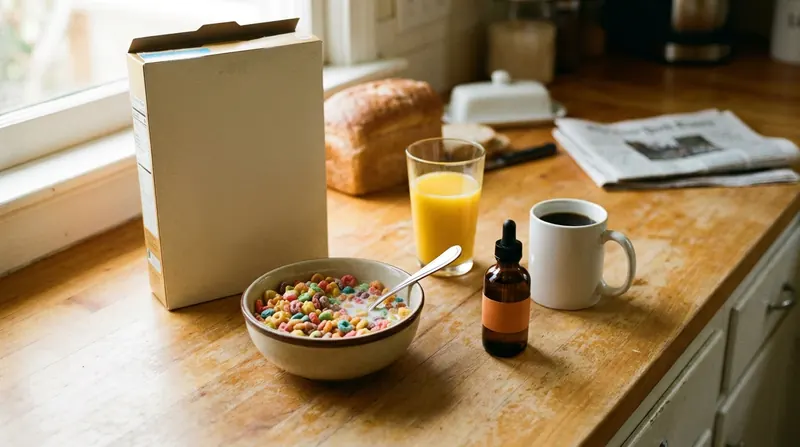
A frosted, honey-coated or chocolate cereal is mostly refined starch and added sugar, and a serving can carry more sugar than a cookie.
No cereal "ages the brain faster than time."
Nobody has measured any such thing, and that phrase was written to be clicked.
What the studies do say is duller, and worth more.
In a Brazilian study of 10,775 adults followed for eight years, the ones who ate the most ultra-processed food lost ground on thinking tests about a quarter faster than the ones who ate the least. [16]
That's an association across a population, not a sentence on your bowl.
The three drinks.
The "evening drink" in our advertisement is alcohol, and it has the strongest case behind it: in 550 British civil servants followed for thirty years, the more a person drank, the faster their word-fluency scores fell, and light drinkers had no edge over those who didn't drink at all. [17]
The second is sugar in a glass: soda, sweetened tea, the tall flavored coffee from the counter.
They sit on the same ultra-processed shelf as the sweet cereal, and that's the honest case against them: sugar you drink without noticing. [16]
The third, in one of our headlines, was coffee.
That was our worst headline.
Plain black coffee and plain tea aren't the drinks any of those studies were about.
Keep your coffee, and count this bottle's half cup along with it. [1]
The three foods.
Processed meat, fried food, and the white-flour shelf: pastries, packaged cakes, white bread.
Our advertisement says "just stop eating these three."
The research says something slower.
In a three-year trial of 604 older adults, one group ate the MIND pattern, vegetables, berries, nuts, whole grains, beans, fish and olive oil, and the other ate its usual diet with a few calories less; both groups' thinking scores rose, by about the same amount. [18]
That's a pattern over years, not a list of three, and even the diet built for it didn't beat plain care with what you eat. [18]
Less sugar in the bowl and the glass.
Less alcohol in the evening.
Keep the coffee.
Eat more like the Mediterranean shelf and less like the vending machine.
The three words, or the three phrases.
There's no such list.
What our advertisement borrowed from is the short, scored mental-status test clinicians have given in person since the 1970s: the date and the place, a few words to hold and give back a minute later, a sum, naming, copying a drawing.
It's read against your age and your schooling by someone trained to do it, and a low score is a reason for a proper look, not a verdict.
Stumbling on a word when you're tired or being timed means nothing on its own.
If the worry behind the click is real, that's fifteen minutes with your own clinician.
And the advertisement about the things some men take every day.
That one sits closest to real research, and it's the one an advertisement has no business acting on.
Some kinds of daily medicine, including a few sold over the counter for allergies and for the night, are on the lists pharmacists check for people over 65.
Don't stop or change any of it because of an advertisement, ours included.
Put everything you take in one bag, this box included, and take it to the pharmacist.
Ask one question: is anything here a poor choice at my age, and does anything here argue with the club-moss line on this panel?
So if you clicked on the cereal, here's where it went: onto the counter beside a small bottle, where the real answer was always a plainer bowl, a fillet of fish, and the coffee you already had.
Note eleven · What it isn'tSix Things a Small Peach Bottle Won't Do
- It won't come with a trial of itself. The one trial with the brand's name tested its capsules, in adults 18 to 35, paid for by the company.
- It won't bring lion's mane to its trial dose. Two hundred fifty milligrams against 3.2 grams a day.
- It won't replace your coffee's alertness with anything stronger. Its clearest effect is half a mug's caffeine.
- It won't sit alongside the brand's capsules. The label says one bottle in twenty-four hours and no other Alpha BRAIN product.
- It won't act on any condition a clinician has named. It's a dietary supplement, and its box carries the sentence that says so.
- It won't tell you which panel is in your box until it arrives. Read it then.
If that list annoys you, I'd rather you were annoyed now than on the sixth morning, with an empty box and no idea which line did anything.
Note twelve · The routineIf You Do Buy It: One Box, the Pharmacist First, Before Lunch, and a Notebook
If you're going to try it, try it as a test with a date on it.
- Buy one box of six. Six mornings is a short test, and that's all a box is.
- Take the box to the pharmacist before the first bottle, with everything else you take. Ask about the club-moss line by name.
- Read the panel on the box that arrives. The theanine, the caffeine source and two more lines depend on which panel you get.
- One bottle, before lunch, never two in a day, and never with the brand's capsules. The label's rules, not mine.
- Count it with your coffee. Half a mug's caffeine, added to what's already in your cup.
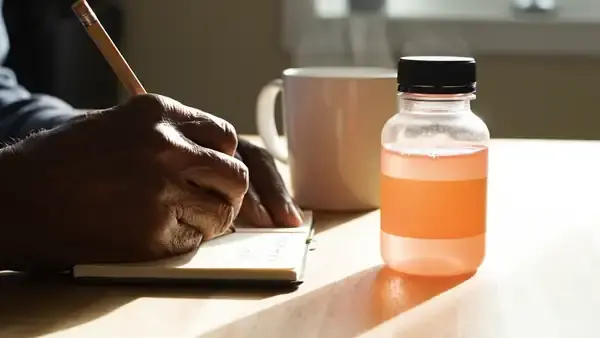
- Write one line a day in a notebook. Not "sharper" or "foggier." What you were doing at ten, and how it went.
- On the seventh morning, read the six lines beside six lines from the week before. That's the only trial of this bottle you'll ever get.
Look at that list the way I do.
Six of the seven things cost nothing.
This is worth a look if:
- You like the idea of a measured, small caffeine dose in a bottle you can carry.
- You've read that theanine and citicoline are at the doses of small trials, and lion's mane isn't.
- You'll take the box to the pharmacist before the first bottle and ask about the club moss.
- You'll keep it to one bottle a day, before lunch, apart from the brand's capsules.
Give it a miss if:
- You take anything daily that the pharmacist says argues with the club-moss line.
- You're sensitive to caffeine, or you already drink three mugs by noon.
- You want a trial of this bottle in men your age. There isn't one.
- You were hoping for the lion's mane dose of the trial. It's a thirteenth of it.
Note thirteen · Where it's soldFrom a Large Online Retailer in Irvine, California, With a Street Address and an Email
The box is sold on iHerb, a large online retailer, and that's the only place this page links to.
The seller is iHerb, LLC, of Irvine, California, which publishes a street address and a customer-support email, and whose listing says returns and refunds follow its own posted policy.
The maker, Onnit Labs, is in Austin, Texas, and its name is on the box.
The price is the one on the retailer's listing on the day you look; this page prints none, because the listing sets it by country and it changes.
Look at it before you click, and look at the shipping line for your address.
Buy one box.
Six mornings is a test, and the pharmacist comes first.
Read the box you get, then read the week you had.
Every line of the panel, with the plain English name, the dose, the trial and who paid for it, is written out in the ingredient and advertising guide linked at the foot of this page.
It also explains the club-moss line for the pharmacist, and says which of our own headlines the bottle does and doesn't support.
Where to get it
A 2.5-ounce peach bottle from Onnit of Austin, Texas: 50 milligrams of caffeine, 250 of citicoline, 250 of lion's mane, 200 of L-theanine and a tenth of a milligram of huperzine A, one bottle a day.
CHECK AVAILABILITYSold by iHerb, LLC, Irvine, California · six 2.5 fl oz bottles · one bottle a day by the label, not at bedtime, not with other Alpha BRAIN products · 50 mg of caffeine per bottle
QuestionsWhat Readers Ask Me Before the First Bottle
Questions readers ask
Is this medicine?
No. It's a dietary supplement, a flavored drink with caffeine, two B vitamins and four other ingredients, sold by an online retailer and made for a Texas company.
Its box carries the standard sentence every American supplement carries, the one that says the Food and Drug Administration hasn't evaluated its claims.
How much caffeine is in it?
Fifty milligrams per bottle, which the label calls half a cup of coffee. A 12-ounce cup of brewed coffee runs from 113 to 247 milligrams, and 400 a day is the figure the Food and Drug Administration cites for most healthy adults. [1]
Will it help my memory?
I can't tell you that, and you should be wary of any page that does. The one trial with the brand's name tested its capsules in people under 35, and nobody has tested this bottle.
What I can tell you is that the caffeine will make you more alert for a while, and that two of the other lines are at the doses of small trials. [2]
What is the club-moss line, and why the pharmacist?
It's a tenth of a milligram of huperzine A, which slows the enzyme that breaks down acetylcholine, a messenger between nerve cells. [11]
Some daily medicines act on that same enzyme, in one direction or the other, so the pharmacist should see the box first.
Can I drink it with the Alpha BRAIN capsules?
The label says no. Don't combine it with any other Alpha BRAIN product, and the capsules carry the same club moss.
Can I drink it in the evening?
The label says not at bedtime. It's half a mug of coffee's caffeine, so before lunch is the sensible time.
Why are there two different panels?
The retailer's printed panel and the maker's page match each other; the photographs of the box on the same listing show a different panel with tyrosine and ashwagandha. Read the panel on the box you receive.
Are there reviews?
Fourteen ratings on the retailer's listing, an average of 4.4, all with the retailer's purchase mark. I quote none, because the store served them only in an automatic translation.
Your advertisement was about a cereal, or three foods, or three drinks. Where is that on this page?
In the tenth note, in full, with the studies. The short version: less sugar in the bowl and the glass, less alcohol in the evening, keep your plain coffee, and eat more like the Mediterranean shelf.
None of it is in the bottle, and the ingredient and advertising guide at the foot goes through every headline we run.
Your advertisement said something about three phrases, or spelling three words. Is there a test I can take?
Not on a screen. The words and phrases come from the short mental-status test clinicians give in person, read against your age and schooling.
If the worry behind the click is real, ask your clinician for the proper test. It's fifteen minutes.
The short versionEverything Above, in Sixty Seconds
- A 2.5-ounce peach bottle from Onnit of Austin, sold by iHerb, one a day, never two in twenty-four hours, never with the brand's capsules, not at bedtime.
- Caffeine: 50 milligrams, half a mug, with a real short-lived effect on alertness; count it with your coffee against the 400-milligram daily figure. [1] [2]
- Theanine: 200 milligrams, the dose of a four-week trial in 30 adults around 48. [5]
- Citicoline: 250 milligrams, the dose of a 28-day attention trial in women 40 to 60, and half the dose of a memory trial in adults 50 to 85. [6] [7]
- Lion's mane: 250 milligrams, about a thirteenth of the 3.2 grams a day in its trial. [9]
- Club moss: a tenth of a milligram of huperzine A, which slows a body enzyme; take the box to the pharmacist first. [11]
- Vitamins: B12 at a dose that makes sense for older stomachs, [12] B6 well under its ceiling. [14]
- Two panels on one listing, a brand trial of the capsules in people 18 to 35, [15] and fourteen ratings averaging 4.4.
- The cereal, three drinks, three foods and the word test from our own advertisements, in the tenth note: less sugar, less alcohol, keep the coffee, and no test on a screen.
The last lineWhat Half a Cup of Coffee in a Peach Bottle Is Actually Worth
Here's the whole thing in one breath.
A measured half mug of caffeine, which works, and two lines at the doses of small trials, which is more than most panels on this desk can say.
A mushroom at a thirteenth of its trial, and a club-moss line that acts on a body enzyme and needs the pharmacist's two minutes.
A box whose photographs and printed panel disagree, and a brand whose one trial tested something else, in people under 35.
And a label, to its credit, that tells you plainly: one a day, alone, not at night.
If you're a man who wants a small, measured caffeine dose with a couple of reasonable lines beside it, who'll show the box to the pharmacist and keep to the label's rules, that's worth one box.
Not because of the stars.
Because you'll know exactly what's in the bottle, and exactly how far each line sits from its trial.
Buy one box, show it to the pharmacist before the first bottle, drink one before lunch and never with the capsules, count it with your coffee, and write one line a day. Six mornings in a notebook will tell you more than this page can.
Check the current price and availability
A 2.5-ounce peach bottle from Onnit of Austin, Texas: 50 milligrams of caffeine, 250 of citicoline, 250 of lion's mane, 200 of L-theanine and a tenth of a milligram of huperzine A, one bottle a day.
CHECK AVAILABILITYSold by iHerb, LLC, Irvine, California · made for Onnit Labs, Austin, Texas · six 2.5 fl oz bottles · read the panel on the box you receive
P.S. If you take one thing from this page, take the two small numbers.
Fifty milligrams, half a mug of coffee.
A tenth of a milligram, the line to name at the pharmacy counter.
P.P.S. If the afternoon fog has been with you for a year, and it's there before the coffee too, talk to your own clinician before you buy anything.
A small bottle was never going to answer a question a clinician answers in fifteen minutes and a blood test.